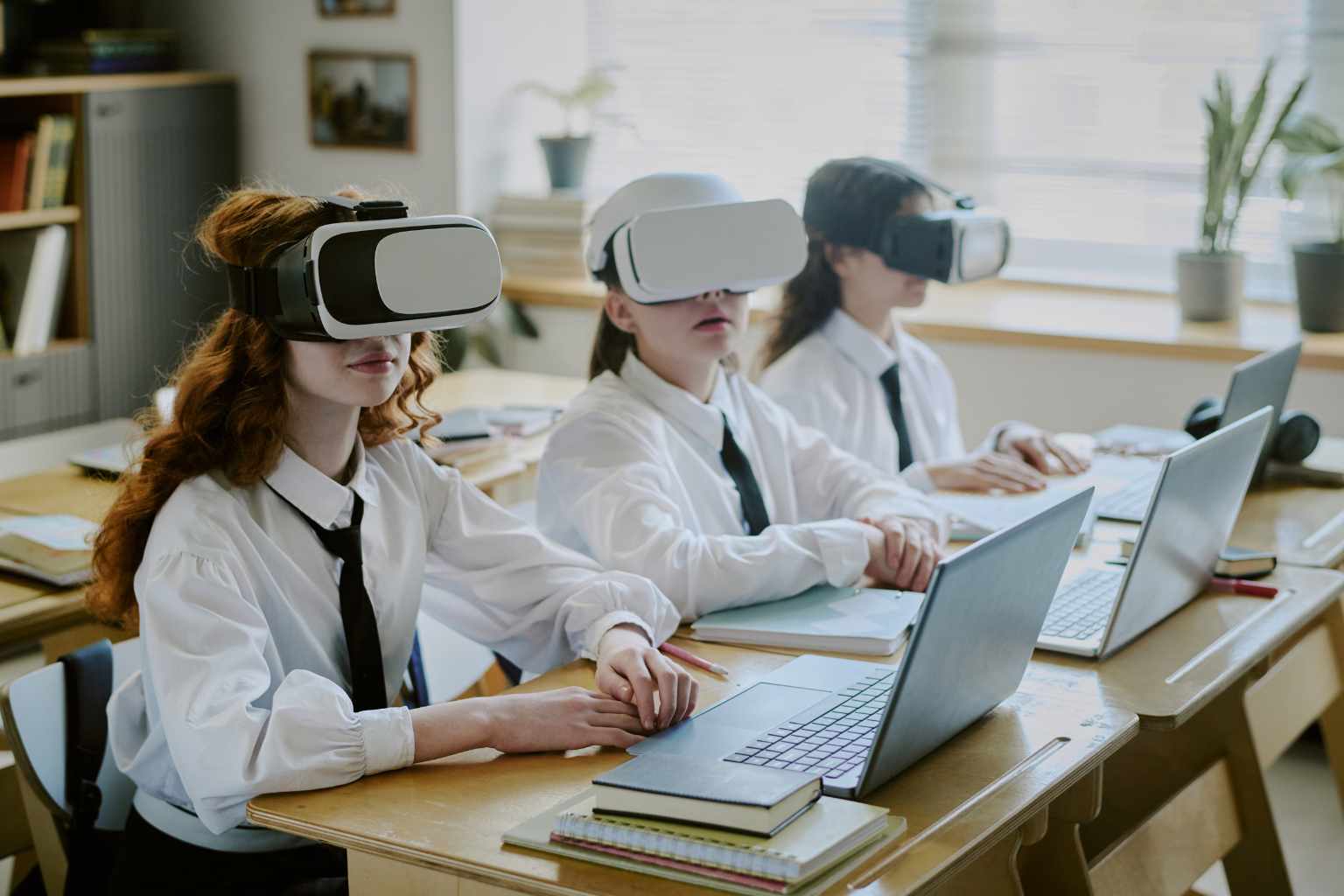
VR is revolutionizing education today by taking learning to a more interactive, exciting and visual level. With the new way of learning, it’s not just about reading from books; students are able to travel around virtual worlds that will enable them to experiment and to comprehend difficult subjects in practice. It speeds up learning because students can stay engaged for longer and have practical experience without using any physical equipment.
1. What Virtual Reality Does in the Classroom
With headsets and digital environments, Virtual Reality can make things feel very real for students. it lets them observe, feel and manipulate lessons as if they are in the middle of the subject itself — which can lead to more meaningful learning.
2. Learning Becomes More Engaging
Students get it better when they can see things happening in front of them. VR allows them to walk inside a forest, navigate the solar system, tour historical monuments or dive into the sea without leaving the classroom.
3. A Better Way to Learn Hard Stuff
Science, math and history are all made more palatable with VR. Students can view experiments, 3D models and step-by-step explanations. This helps to continue with less confusion and more confidence.
4. Real Life Training Without Risk
VR gives students studying medicine, engineering and aviation a way to practice real life scenarios without the risk. In training, they can operate on people without making a mistake, fix machines or fly aircraft in simulation.
5. Why VR is going to grow in learning rapidly
The following are the main factors influencing VR’s growth in this sector of education:
- More affordable VR devices
- Better internet access
- New interactive learning apps
- Higher student interest
- Schools focusing on digital learning
These are the reasons why VR is a must for schools of the future.
6. Improves Memory and Understanding
When students experience lessons visually and physically, they remember information for a longer time. VR learning increases retention because it activates multiple senses during the lesson.
7. Technologies That Support VR Learning
VR learning is supported with 3D animation, motion tracking, AI driven tutor and application layers of immersion. Such technologies support the development of immersive learning experiences for learners to learn at their pace.
8. Hurdles for School to Adopt VR
Yet, for all its wonders, VR has its downside. Here are the main issues:
- Costliness of VR gear for certain schools
- Need for teacher training
- May cause eye strain after hours long use
- Requirement of strong internet connections
Schools are slowly addressing some of these issues to make VR learning more accessible.
9. How VR Helps Various Types of Learners
Teaching is visual, kinesthetic learning focused. VR supports all learning styles. It allows slow learners to review lessons and makes it easier for fast learners to experience advanced material.
10. The Future of VR in Education
The future of VR in education is very promising. Labs, virtual tours and collaborative projects School and college laboratories are fading into memory, while institutions adopt VR for training, education, even conducting school orchestras. By providing every student, regardless of location, with the same experience, VR will help make education more equal.
Key Takeaways
- VR adds an interactive learning element and just makes learning fun
- Many students comprehend abstract topics better using imagery
- Practice in VR allows for safe and realistic practice of real world tasks.
- Technology makes lessons more interesting and exciting
- I believe future of education would have more VR based learning tools
FAQs:
Q1. What is Virtual Reality in Laymans Terms?
It’s a technology that recreates in such precise detail that otherworldliness that students can marvel at it and move through it.
Q2. How does VR impact the learning of students?
It includes visuals and interactive tools that can help make lessons easier to understand.
Q3. Is VR safe for students?
Yes, but in small blocks so as not to tire the eyes.
Q4. Can VR replace teachers?
No, it automatically enhances teaching by being more interesting, not by supplanting it.
Q5. What kinds of classes are most effective with VR?
Science, history, math, geography and skills training are the big beneficiaries.